The Silent Expansion of Biometric Surveillance
The detention of Jesus Gutiérrez marks a critical inflection point in the relationship between civil liberties and state surveillance capabilities. For decades, the strategic assumption has been that U.S. citizenship provides an impenetrable shield against immigration enforcement tactics. However, the deployment of ICE’s facial recognition technology has fundamentally altered this landscape, creating a biometric dragnet that no longer distinguishes between citizens and suspects by default.
This is not an isolated glitch in an otherwise efficient system; it is a feature of a new operational paradigm. According to Revealnews's investigation into wrongful detentions, at least 170 U.S. citizens have been detained since the previous administration, often triggered by the technology’s inability to process claims of citizenship accurately. The reliance on algorithmic adjudication over human verification introduces a dangerous "Efficiency Trap," where the speed of digital processing overrides the necessity of due process.

The Mobile Fortify Protocol
The operational shift is driven by the aggressive rollout of tools like the "Mobile Fortify" app. By decentralizing biometric verification, agencies have effectively turned every field agent into a mobile checkpoint with the power of a sovereign tax authority. As detailed in Wired's report on mobile tool deployment, this technology allows for real-time identity verification in the field, bypassing traditional oversight mechanisms found at static ports of entry.
This capability creates a profound asymmetry in the field:
- Zero-Consent Data Capture: Agents can demand biometric data without offering an opt-out mechanism.
- Algorithmic Authority: The software’s "match" is often treated as definitive, despite known error rates.
- Ecosystem Dominance: The database grows with every scan, creating a self-reinforcing loop of surveillance data.
For campaign strategists and policy analysts, this represents a pivot from targeted enforcement to mass data ingestion. The question is no longer whether the technology works perfectly, but whether the legal frameworks can evolve fast enough to contain its automated leverage over the citizenry.
The Biometric Checkpoint: Your Life, Transformed
The detention of a U.S. citizen based on a software glitch is not an isolated anomaly; it is a symptom of a fundamental shift in the social contract. We are moving from a model where identity is asserted via physical documentation to one where it is validated via biometric interrogation. In this new paradigm, your face is no longer just your likeness—it is a readable, trackable barcode permanently exposed to the public sphere.
This transformation relies on a vast, often invisible backend infrastructure that repurposes civilian data for enforcement objectives. It is not merely about federal watchlists; it is about the co-opting of state-level datasets originally intended for administrative purposes.
The Dissolution of Data Sovereignty
The operational power of tools like Mobile Fortify depends entirely on the depth of the reference database. The New York Times's investigation into state databases reveals that ICE has mined millions of driver's license photos to fuel these recognition engines. This creates a scenario of "functional warrantless searches" at scale, where data provided for the privilege of driving is leveraged for criminal and immigration enforcement without explicit consent.

For campaign strategists and civic leaders, this represents a critical "Scope Creep" risk. When administrative data is weaponized, public trust in foundational government services—like the DMV—erodes rapidly.
The Algorithm as Judge
The danger lies in the "Black Box" nature of the verification process. When an algorithm flags a match, the psychological tendency of the human operator is to trust the machine over the human standing in front of them. This creates a dangerous feedback loop where technological probability supersedes legal presumption of innocence.
- The Efficiency Trap: Agencies prioritize speed of processing over accuracy of adjudication.
- Asymmetric Burden: The citizen must prove the machine wrong, often while detained and without access to the underlying data.
- Regulatory Lag: Deployment has far outpaced governance.
CSIS's analysis of the legislative landscape highlights the massive gap between the rapid deployment of these tools and the establishment of responsible use principles. Until this gap is closed, every citizen interaction with law enforcement carries the statistical risk of becoming a false positive in a database they never agreed to join.
The Mobile Fortify Ecosystem
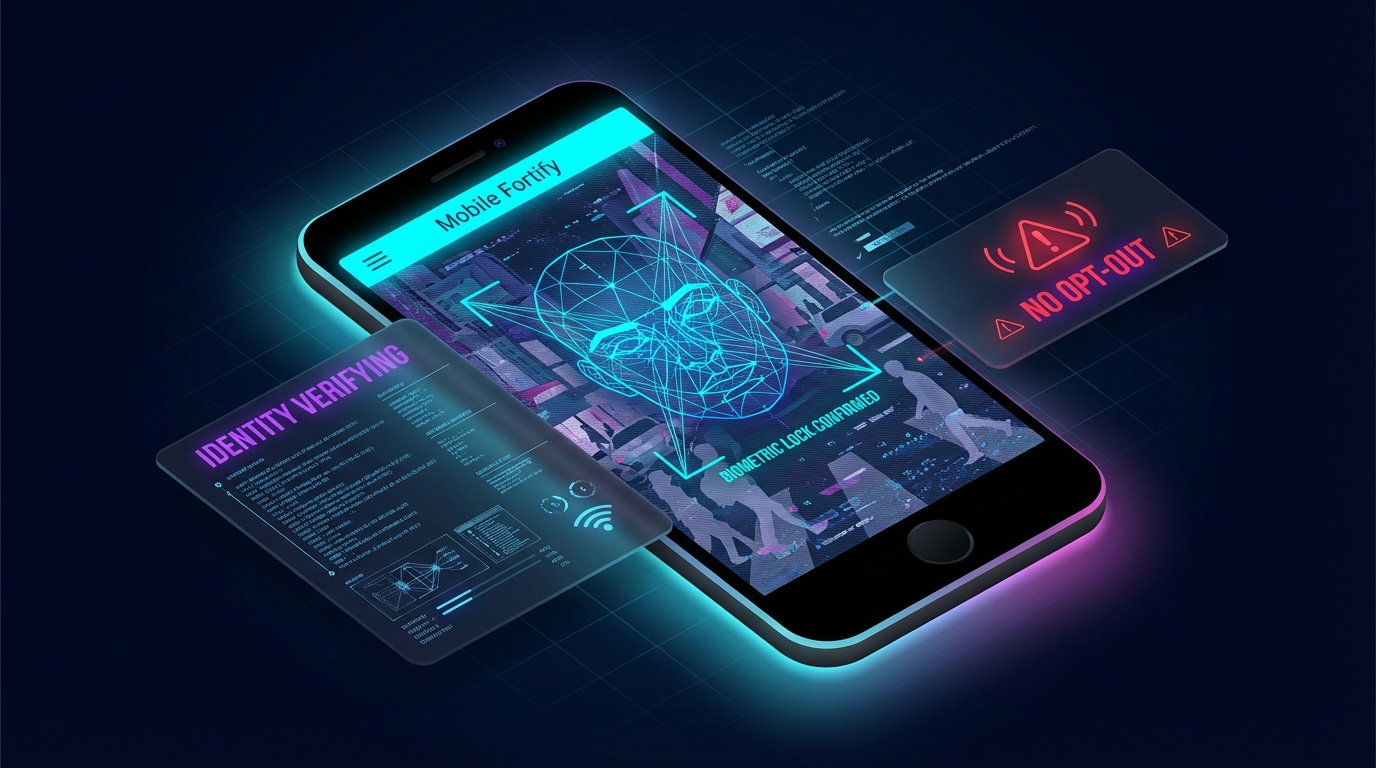
The operational reality of immigration enforcement has shifted from static physical checkpoints to dynamic, algorithm-driven interactions. At the center of this transformation is Mobile Fortify, an application that effectively turns every agent’s smartphone into a biometric dragnet. This represents a fundamental change in how the state interacts with individuals: identity verification is no longer a dialogue based on documents, but a unilateral data extraction process.
The "Zero-Option" Interface
In traditional data exchange models, user consent is the primary gatekeeper. However, ICE’s deployment of this technology operates on a mandatory compliance framework. Agents in the field are equipped with tools designed to bypass negotiation, creating a scenario where the technological imperative overrides civil liberties.
According to Slashdot's report on DHS documentation, the system architecture explicitly precludes an "opt-out" mechanism. When an agent initiates a scan, the subject cannot legally or technically decline, regardless of their citizenship status. This creates a coercive digital environment where the refusal to submit to biometric digitization is treated as an admission of guilt or non-compliance.
The Data Retention Engine
The strategic implication of this technology extends far beyond the moment of the scan. We are witnessing the creation of a long-tail surveillance asset. The data captured—facial geometry, location metadata, and time stamps—does not evaporate after verification; it feeds into a massive, persistent repository.
A Government Report's privacy impact assessment reveals that this biometric data is integrated into broader DHS systems, creating a permanent digital footprint for individuals who may have never been charged with a crime. This transforms a momentary police encounter into a permanent data entry, stored for years, subject to future algorithmic analysis that the individual cannot audit or contest.
The Operational Risks:
- Shadow Profiling: Citizens are entered into criminal databases simply by proximity to an investigation.
- Algorithmic Drift: Older data may be re-analyzed by newer, untested algorithms years later.
- Security Vulnerability: Centralized biometric caches are high-value targets for cyber espionage.
The Accuracy Paradox
The business case for Mobile Fortify rests on the promise of "operational efficiency"—processing subjects faster to clear cases. However, this efficiency creates a dangerous trade-off with accuracy. As NPR's analysis of immigration tracking tools suggests, the deployment of these "spyware-adjacent" technologies prioritizes speed and volume over the granular precision required to protect constitutional rights.
When speed becomes the primary KPI (Key Performance Indicator), the "human in the loop" acts less as a safeguard and more as a rubber stamp for the machine's decision. This is the Automation Bias Trap: agents are psychologically conditioned to trust the "green checkmark" on the screen over the physical passport in the subject's hand.
Strategic Implication: The End of Anonymity?
For campaign professionals and policy analysts, this signals a macro-trend toward Total Information Awareness in the public sphere. The infrastructure being tested on immigrants today establishes the technical and legal precedents for the universal surveillance of tomorrow. If a U.S. citizen can be detained because an algorithm flagged a false positive, the presumption of innocence has been effectively outsourced to a black-box vendor.
Mobile Fortify: The Core Mechanics Unveiled
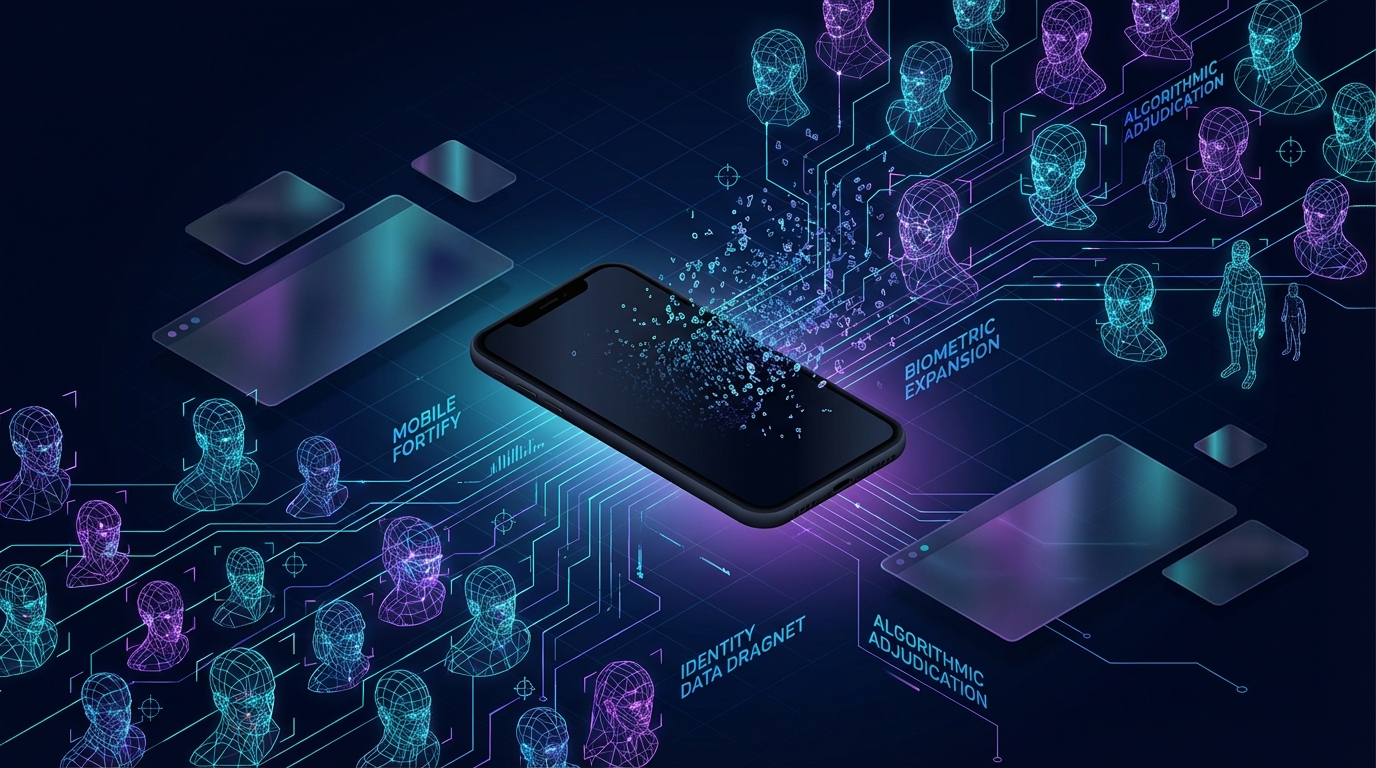
The operational pivot from manual verification to algorithmic adjudication relies on a specific piece of infrastructure: Mobile Fortify. This isn't merely a scanning app; it is a portable terminal connected to one of the world's largest biometric data lakes. For campaign strategists analyzing government tech stacks, Mobile Fortify represents the ultimate "force multiplier"—allowing a single field agent to access the computational power of the entire Department of Homeland Security (DHS) in real-time.
The workflow is deceptively simple but structurally coercive. When an agent encounters a subject, the app captures facial geometry and fingerprints, bypassing traditional identification documents entirely. According to the Department of Homeland Security's AI inventory, this technology is explicitly categorized for identity verification, yet it operates with a "black box" methodology that obscures the decision-making criteria from both the agent and the subject.
The Coercive Architecture
The user experience (UX) of Mobile Fortify is designed for unilateral data extraction. Unlike consumer technology where consent is a prerequisite, this interface offers no "opt-out" mechanism. The architecture assumes the subject is a data point to be processed rather than a citizen with rights to be respected.
This creates a "Compliance Loop" where refusal is treated as an admission of guilt. Cato Institute's analysis highlights that without strict legislative guardrails, this technology transforms every interaction into a potential constitutional violation. The system forces individuals—including citizens—to prove a negative (that they are not undocumented) using a biometric key they cannot change or revoke.
The Data Lake Effect
The true power—and danger—of Mobile Fortify lies not in the phone, but in what it connects to. The scan queries the Automated Biometric Identification System (IDENT), a repository holding over 270 million records.
This creates a "Big Data Paradox": as the dataset grows, the probability of a false positive match increases mathematically, yet the system's confidence score remains static.
| Feature | Traditional ID Check | Mobile Fortify Scan |
|---|---|---|
| Verification Source | Physical Document (Passport/ID) | Probabilistic Algorithm |
| Error Rate | Low (Human verification) | Variable (Algorithmic bias) |
| Data Retention | None (Visual check only) | 15 to 75 Years |
| Burden of Proof | On the Officer | On the Algorithm |
As Wired reports on the DHS data strategy, this aggregation of data puts U.S. citizens at distinct risk of "digital entrapment." The system doesn't just verify identity; it permanently logs the encounter, creating a longitudinal surveillance record of innocent civilians. For the campaign professional, this illustrates the danger of unlimited data retention policies—where today's efficiency tool becomes tomorrow's liability engine.
Strategic Implication: The Efficiency Paradox
We are witnessing the industrialization of immigration enforcement. By removing the friction of manual checks, agencies have also removed the friction of due process. The system is optimized for throughput, not accuracy, creating a scenario where it is operationally cheaper to detain a citizen based on a software glitch than to invest in the human intelligence required to verify their status correctly.
The Biometric Dragnet: From Borders to Backyards
The incident involving Jesus Gutiérrez is not a systemic glitch; it is a feature of a rapidly expanding surveillance ecosystem. We are witnessing a strategic shift toward "mission creep," where battlefield-grade identity verification tools are seamlessly integrated into routine domestic law enforcement. What begins as a tool for border control inevitably filters inward, normalizing the biometric scanning of populations far removed from any port of entry.
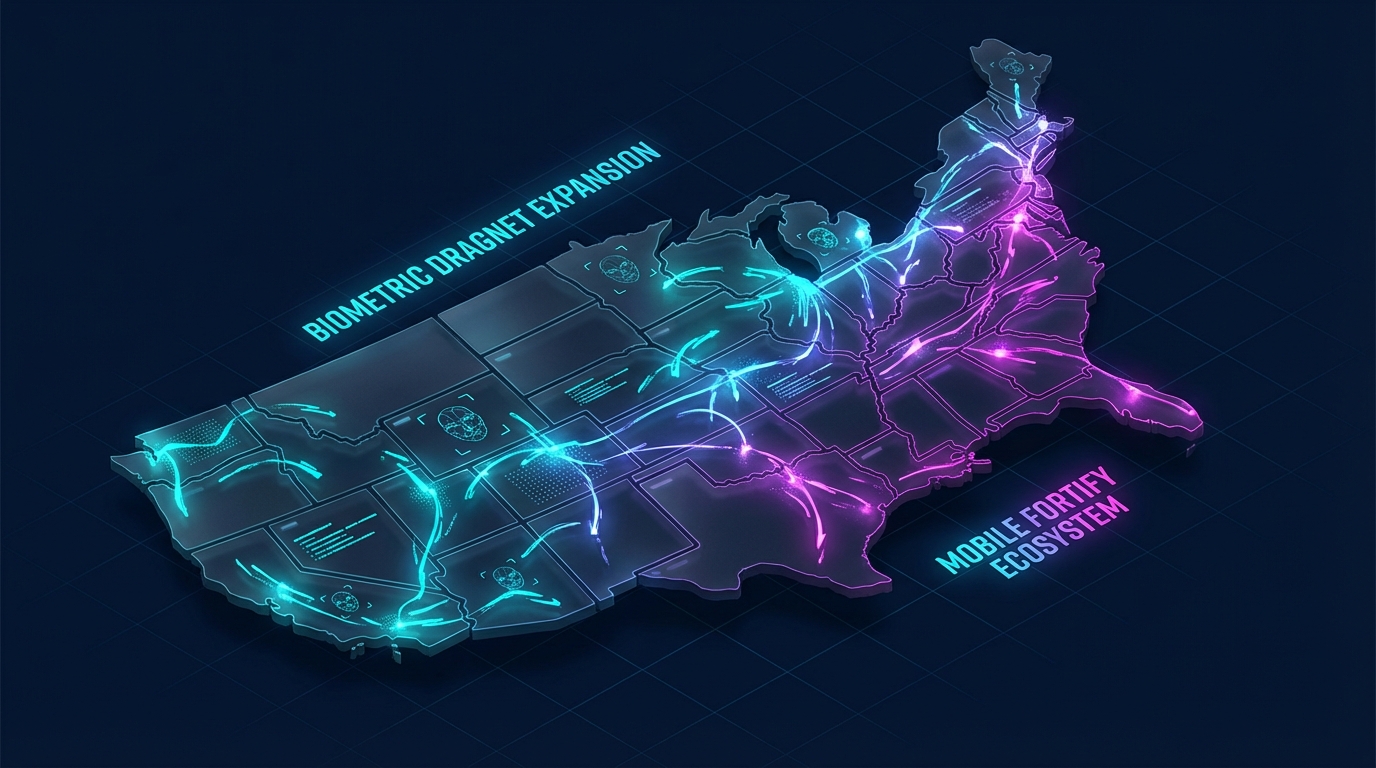
This technology does not discriminate based on citizenship status once deployed in the field; it captures data indiscriminately to feed the algorithm. As noted in the American Immigration Council's analysis of mass surveillance expansion, the infrastructure originally built for targeted immigration enforcement is increasingly being repurposed for broader domestic monitoring. When agencies normalize the scanning of citizens merely to "rule them out," the foundational presumption of privacy evaporates.
The Legislative Vacuum
The most alarming aspect for strategic planners is the regulatory void in which these tools operate. Innovation cycles in biometric technology are measured in weeks, while legislative cycles drag on for years, creating a massive governance gap. According to a report by the National Academies regarding this legislative gap, advancements in facial recognition have vastly outpaced the laws meant to govern them, leaving civil liberties vulnerable to unchecked technological application.
This creates a "gray zone" of enforcement where agencies operate with de facto impunity until challenged in court.
- The Consent Illusion: If refusing a scan results in detention, "consent" is coerced, not voluntary.
- The Data Lake Effect: Innocent citizens' data is often retained to train the very algorithms used to surveil them.
- The Liability Shift: The burden of proof shifts from the state proving guilt to the citizen proving identity via biometric surrender.
Strategic Implication: The Permission-Based Society
We are moving toward a model where biometric verification is the toll paid for freedom of movement. For campaign professionals and policy analysts, this signals a critical pivot point in civil rights advocacy. The argument is no longer about "illegal immigration"; it is about the establishment of a permanent digital checkpoint system applied to the entire populace. The silence of legislative bodies on this specific application of Mobile Fortify suggests a tacit acceptance of this new normal, where anonymity is treated as a suspicious anomaly rather than a right.
The Biometric Baseline: Future Strategic Horizons
We are witnessing the beta-testing of a new governance architecture. The deployment of Mobile Fortify is not merely an isolated enforcement tactic; it represents the prototyping of a biometric national ID system established through administrative fiat rather than legislative consent. For campaign strategists and policy analysts, this distinction is critical. We are moving from a society where anonymity is the default state to one where verified identity is the prerequisite for presence.
The False Positive Paradox
The future of this technology introduces a significant operational risk: the "False Positive Paradox." As databases like ICE’s swell to hundreds of millions of images, even a statistically negligible error rate translates into thousands of wrongful detentions.
- The Scale Problem: A 99% accuracy rate on a database of 200 million still leaves 2 million potential errors.
- The Correction Deficit: There is currently no robust, agile infrastructure to "patch" a human identity once an algorithm flags it as a threat.
- The Automaton Effect: Field agents increasingly defer to the "black box" decision of the app over their own observation or valid physical documentation.
According to Americanbar's analysis of facial recognition technology, we are entering a legal landscape where the lack of regulation creates a vacuum of accountability. In this environment, the burden of algorithmic auditing falls on the accused, not the state.
Strategic Forecast: The Compliance Cascade
If Mobile Fortify proves operationally "efficient" for ICE, expect a rapid lateral expansion of this technology. The tools used today to verify citizenship status at the border will likely be adapted tomorrow for secure access to public benefits, transportation hubs, and voting booths. The strategic narrative is shifting from "hunting criminals" to "frictionless verification," a rebrand that masks the profound erosion of civil liberties behind the promise of administrative speed.
TL;DR — Key Insights
- ICE's facial recognition tech, like Mobile Fortify, is scanning U.S. citizens, blurring lines of immigration enforcement and civil liberties.
- At least 170 U.S. citizens have been wrongly detained due to this technology's inaccuracies and reliance on algorithms over human verification.
- This biometric dragnet captures data without consent, creating permanent digital footprints and shifting the burden of proof to the individual.
- The rapid deployment of this tech far outpaces current legal frameworks, creating a significant regulatory void and risk of systemic abuse.
Frequently Asked Questions
What is ICE's facial recognition technology and how does it work?
ICE utilizes technologies like the "Mobile Fortify" app, which allows agents to scan individuals' faces in the field. This data is compared against a large biometric database, potentially leading to identity verification or flagging for further scrutiny.
Can U.S. citizens be scanned by ICE's facial recognition technology?
Yes, the article highlights that U.S. citizens have been scanned and even wrongly detained by ICE's facial recognition technology. The system's algorithms can misidentify individuals, and citizenship claims may not be immediately accepted without biometric verification.
What are the risks associated with ICE's facial recognition scans?
Risks include being wrongly detained, the creation of permanent digital footprints without consent, and the burden of proving your identity shifting to the individual. The technology's error rates and reliance on algorithms over human judgment are significant concerns.
Has the U.S. government addressed the use of facial recognition by ICE?
The article suggests a significant regulatory void exists. The rapid deployment of this technology has far outpaced the development of laws and governance principles to control its use, leaving civil liberties vulnerable to unchecked application.