The Sovereignty Shift: Why Open and Small Models Dominate
The monolithic era of AI—defined by renting intelligence from a handful of centralized "sovereign tax authorities"—is rapidly eroding. For strategic decision-makers, the prevailing logic that scale equals success is being dismantled by a new imperative: operational sovereignty. The future of campaign technology and enterprise intelligence is not about building larger models, but about deploying smarter, more efficient ones that you control.
We are currently witnessing a massive migration toward data independence. The market is signaling a decisive break from the "Black Box" dependency of closed proprietary systems. According to Menlo Ventures' 2025 market analysis, enterprise adoption of open-source LLMs is projected to hit 60%, a staggering leap from just 25% in 2023. This is not merely a technical preference; it is a strategic maneuver to escape vendor lock-in and the escalating costs of token-based pricing models.
The Rise of the Zero-Marginal-Cost Engine
Simultaneously, the "bigger is better" fallacy is collapsing under the weight of its own inefficiency. Enter the Small Language Model (SLM). These compact, high-performance engines allow organizations to decouple intelligence from massive cloud infrastructure.
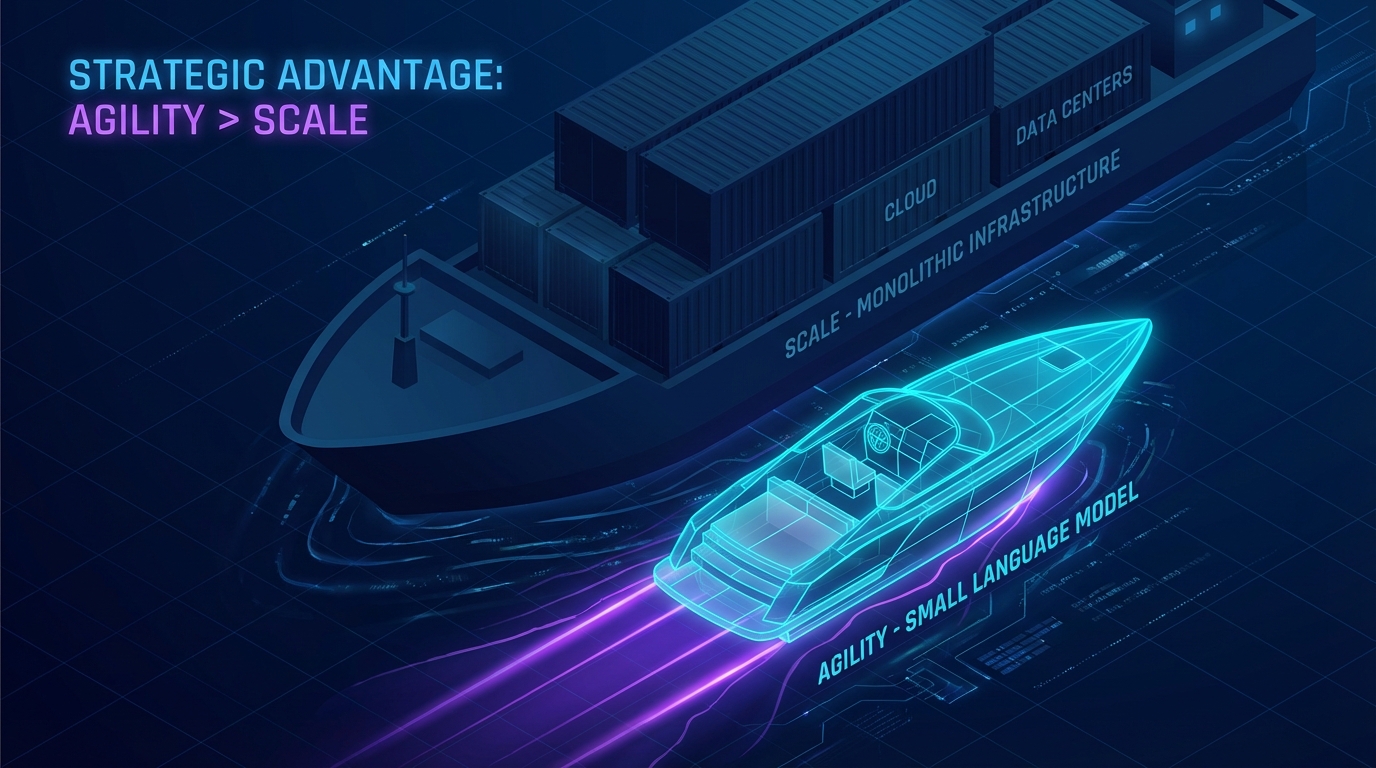
The strategic advantage of SLMs lies in their ability to deliver "operational excellence" on edge devices with minimal latency. As highlighted in Microsoft's report on the Phi-3 series, these "tiny but mighty" models enable enterprises to bypass the privacy risks and connectivity requirements inherent in cloud-dependent architectures.
Why this matters now:
- Data Governance: You cannot secure what you do not own. Open models allow for full auditability of the inference stack.
- Cost Velocity: Moving from variable API costs to fixed infrastructure costs stabilizes long-term burn rates.
- Latency Arbitrage: On-device SLMs eliminate the round-trip time to the cloud, enabling real-time interaction critical for campaign responsiveness.
However, this shift introduces the "Ownership Paradox." While adopting open architectures eliminates the recurring "tax" paid to proprietary vendors, it transfers the burden of model optimization and maintenance back to your internal teams. The competitive edge now belongs to those who can manage this complexity, not just those who can pay for access.
The Democratization of Campaign Intelligence
The shift toward Small Language Models (SLMs) represents a fundamental decoupling of high-level intelligence from heavy infrastructure. We are transitioning from a centralized "oracle" model—where every query must travel to a massive, energy-hungry data center—to a distributed mesh of specialized intelligence. This democratization allows campaign field offices and local data teams to deploy sophisticated analytical tools on standard hardware, bypassing the need for enterprise-grade GPUs.

This efficiency is not merely a technical detail; it is a strategic asset. According to IBM's analysis of model architectures, SLMs achieve high performance with significantly fewer parameters, enabling them to execute complex reasoning tasks in resource-constrained environments. This allows nimble teams to fine-tune models for specific voter demographics or hyper-local policy nuances rather than relying on a generalized, one-size-fits-all giant.
The Edge Advantage: Speed as a Weapon
The true transformation lies in the ability to deploy AI at the "edge"—directly on smartphones, tablets, and field laptops. In a high-stakes campaign, the latency introduced by cloud-dependent architectures can be the difference between capturing a voter sentiment in real-time and missing the window of opportunity.
IEEE Spectrum highlights this innovation, noting that moving inference to the edge significantly enhances privacy and responsiveness. By processing sensitive constituent data locally, campaigns can utilize advanced sentiment analysis without that data ever leaving the secure device, effectively neutralizing many cybersecurity risks associated with cloud transmission.
The Fragmentation Trap
However, this distributed power brings a new strategic vulnerability: Insight Siloing.
When every department runs its own specialized SLM—one for fundraising, one for canvassing, another for opposition research—the organization risks fracturing its narrative. If the "Fundraising Brain" learns a donor is fatigued, but the "Canvassing Brain" doesn't receive that signal because it operates on a separate local instance, the campaign becomes disjointed. The challenge for leadership is no longer just acquiring AI, but orchestrating a unified protocol across a fleet of independent, intelligent agents.
The Sovereign Intelligence Shift: Beyond the API Rental Model
The "Fragmentation Trap" is a solvable logistical hurdle, but the alternative—continuing to rely exclusively on proprietary, closed-source models—presents a far greater strategic risk: Cognitive Vendor Lock-in.
For the past three years, the dominant AI strategy for most campaigns and enterprises has been the "API Rental Model." Organizations pay a toll to access a massive, generalized intelligence hosted on a third-party server. While convenient, this model essentially outsources the organization's brain. You do not own the model, you cannot inspect the logic, and your data flows into a black box.
The core idea driving the future of open source and Small Language Models (SLMs) is the pivot toward Sovereign Intelligence. This is the transition from renting generic cognition to owning specialized, high-efficiency assets that live within your own infrastructure.
The Closing Quality Gap
The primary argument against open-source models—that they lack the reasoning capabilities of their proprietary counterparts—is rapidly evaporating. We are witnessing a decoupling of "size" from "intelligence."
For specialized industrial and campaign tasks, the performance delta is often negligible. According to Arxiv's comparative analysis of industrial applications, the functional gap between top-tier open-source models and proprietary giants has narrowed significantly, particularly in machine reading comprehension and specific data extraction tasks.
The Strategic Insight: You do not need a trillion-parameter model to summarize a voter file or draft a fundraising email. Using a frontier model for these tasks is akin to commuting to the office in a Formula 1 car—excessively expensive and operationally fragile.

The Rise of "Tiny but Mighty" Compute
The economic engine of this shift is the Small Language Model. By reducing parameter counts, organizations can run sophisticated AI on commodity hardware or even edge devices, bypassing the massive cloud costs associated with proprietary APIs.
This is not merely about cost cutting; it is about operational latency and availability. As detailed in Microsoft's detailed overview of the Phi-3 architecture, modern SLMs are engineered to deliver "big model" reasoning capabilities while fitting on a smartphone. For a campaign field director, this means having a powerful AI assistant running locally on a tablet in a rural district with zero internet connectivity—a capability the API Rental Model simply cannot provide.
The Hybrid Architecture Strategy
The winning strategy for 2025 is not a binary choice between "Big and Closed" or "Small and Open." It is an orchestrated hybrid.
Forward-thinking CTOs are deploying what Forbes's strategic assessment of hybrid architectures identifies as the "Hybrid SLM-LLM Model." In this framework:
- The Generalist (Proprietary LLM): Handles broad, ambiguous reasoning tasks where world knowledge is key.
- The Specialist (Open Source SLM): Handles high-volume, repetitive, and privacy-sensitive tasks (PII processing, internal document analysis).
This approach allows organizations to maintain Data Sovereignty—keeping sensitive donor and strategy data on local SLMs—while still leveraging the creative power of larger models when necessary. It converts AI from a variable operating expense into a fixed, owned asset.
The Sovereign Compute Engine: Why Small Wins Big
The narrative that "parameter count equals performance" is rapidly becoming a strategic fallacy. For C-suite leaders and campaign directors, the shift toward Open Source and Small Language Models (SLMs) is not merely a technical adjustment—it is a correction of the "Intelligence-to-Cost Ratio."
While proprietary trillion-parameter models excel at creative ambiguity, they represent massive operational overhead for deterministic tasks. The future of campaign infrastructure relies on Compute Sovereignty: the ability to own, audit, and deploy intelligence without paying a perpetual "rent" to centralized AI providers.

The Edge Intelligence Advantage
The most immediate strategic value of SLMs is the decoupling of intelligence from connectivity. Traditional LLMs require constant API calls to centralized servers, introducing latency and data leakage risks. In contrast, SLMs are designed for "Edge AI"—running directly on laptops, tablets, or local servers.
According to IEEE Spectrum's analysis of Edge AI innovation, this capability transforms how organizations handle sensitive data. By processing information locally, campaigns can deploy AI tools in field offices with poor connectivity or in high-security environments where data must never leave the device. This creates a Zero-Latency Feedback Loop where insights are generated instantly, rather than waiting for cloud processing.
The Transparency Imperative
Proprietary models operate as "Black Boxes." You input data and receive an output, but the logic, biases, and safety filters are opaque. For political campaigns and enterprise strategists, this lack of visibility is a liability.
Open-source architectures mitigate this risk by offering total inspectability. As highlighted in Arxiv's review of trustworthy AI architectures, the ability to scrutinize the underlying code and training methodology is essential for establishing robust, ethical standards.
Strategic Implications of Open Source:
- Auditability: Verify exactly how the model reaches conclusions.
- Safety customization: Implement custom guardrails rather than relying on a vendor's generalized safety policy.
- Vendor independence: Eliminate the risk of a provider deprecating a model version your infrastructure relies on.
The New Unit Economics of Intelligence
The financial argument for the open/small approach is undeniable. Renting intelligence via API is an operating expense (OPEX) that scales linearly with usage. Deploying an open-source SLM is a capital expense (CAPEX) that amortizes over time.
Menlo Ventures' 2025 market update indicates a significant shift in the foundation model landscape, suggesting that the economics are favoring models that balance performance with cost-efficiency. By fine-tuning a smaller, open model on proprietary data, organizations can achieve 95% of the performance at 10% of the inference cost compared to giant proprietary models.
The Bottom Line: The "bigger is better" era is over. The new competitive advantage lies in precision—using agile, transparent, and owned models to execute specific tasks with ruthless efficiency.
Decentralization: The Unexpected Fallout
The migration from "rented" intelligence (Proprietary APIs) to "owned" intelligence (Open Source/SLMs) creates a massive transfer of liability. When an organization relies on OpenAI or Google, they are paying a premium not just for compute, but for indemnification and safety rails.
When you deploy an open-source model, that safety net vanishes. You become the sovereign authority over your AI infrastructure, which means you also inherit the sovereign debt of risk management.

The Transparency Paradox
The primary selling point of open-source—code transparency—is simultaneously its most dangerous vector. While visibility allows for auditability, it also provides a roadmap for bad actors. Architectural transparency is a gift to attackers.
SearchUnify’s analysis of adoption challenges highlights this security duality. While proprietary models operate as "black boxes" that obscure their vulnerabilities, open-source models require organizations to build their own fortresses around the model weights. If a proprietary model hallucinates or leaks data, the vendor is often the first line of defense; with open source, your security team is the only line of defense.
The Compliance Burden
Beyond security, the ethical burden shifts entirely to the user. Proprietary giants spend millions on Reinforcement Learning from Human Feedback (RLHF) to sanitize outputs and prevent toxic responses. Raw open-source models often lack these aggressive filters to preserve flexibility.
This creates a "Compliance Trap." Organizations must now engineer their own alignment protocols. Arxiv’s review of ethical considerations emphasizes that responsible development in this new era requires robust internal policy frameworks that many enterprises simply do not have. The study suggests that without the centralized curation of major vendors, the risk of deploying biased or harmful agents increases exponentially if not actively managed.
The Strategic Implication: The cost savings of SLMs are real, but they are often offset by a "Talent Tax." You no longer need just prompt engineers; you need MLOps specialists and AI ethicists to manage the infrastructure and liability that Big Tech used to handle for you.
| Risk Vector | Proprietary API Model | Open Source / SLM |
|---|---|---|
| Data Leakage | Vendor Risk | Internal Security Risk |
| Bias Mitigation | Managed by Vendor | Managed by Your Team |
| System Uptime | SLA Dependent | In-House Responsibility |
| Liability | Shared | Absolute |
Strategizing for the Sovereign AI Era
The transition from "renting" intelligence via APIs to owning your cognitive architecture is no longer a technical preference—it is a strategic imperative. As the previous risk assessment demonstrates, the liability of reliance on black-box models is becoming untenable for data-sensitive enterprises. The future belongs to organizations that treat AI not as a vendor service, but as a core internal asset.

Escaping the "Generalist Trap"
A common strategic failure is forcing a single, massive proprietary model to handle every workflow. This is the Efficiency Trap: paying premium inference costs for tasks that a specialized SLM could handle faster and cheaper.
To build a sustainable AI roadmap, leaders must adopt a Tiered Cognitive Stack:
- Tier 1 (The Sovereign Core): Deploy open-source heavyweights (like Llama 3 or Mixtral) within your private cloud for complex reasoning tasks requiring deep context and absolute data privacy.
- Tier 2 (The Edge Specialists): Implement SLMs on employee devices for low-latency tasks like coding assistance or document summarization. This eliminates data egress entirely.
- Tier 3 (The Vendor Fallback): Reserve proprietary APIs only for generic, non-sensitive queries where world-knowledge exceeds internal domain expertise.
Immediate Tactical Moves
To execute this, move beyond theoretical piloting. Instaclustr’s analysis of the top open source contenders for 2025 highlights that models like Llama 3, Mistral, and Falcon are now mature enough to replace proprietary systems in enterprise workflows.
Your 90-Day Action Plan:
- Data Audit: Categorize workflows by "Privacy Tier." If it involves PII or IP, it must leave public APIs immediately.
- SLM Pilot: Select one high-volume, low-complexity task (e.g., internal ticket routing) and fine-tune a sub-7B parameter model.
- Talent Realignment: Shift engineering focus from "Prompt Engineering" to "Model Ops" and fine-tuning.
The organizations that win this decade will not be those with the biggest API budget, but those with the most efficient, sovereign, and specialized model ecosystem.
TL;DR — Key Insights
- Open-source LLMs and SLMs offer operational sovereignty, escaping vendor lock-in and rising token costs, with enterprise adoption projected to reach 60% by 2025.
- Small Language Models (SLMs) provide "operational excellence" on edge devices, minimizing latency and privacy risks, enabling real-time interaction critical for campaigns.
- The future demands owning specialized, high-efficiency AI assets rather than renting generalized cognition, with performance decoupling from massive parameter counts.
Frequently Asked Questions
What is the main advantage of open-source LLMs and Small Language Models (SLMs)?
Open-source LLMs and SLMs offer operational sovereignty, allowing organizations to control their AI infrastructure, avoid vendor lock-in, and escape escalating token-based pricing models. This leads to greater data independence and strategic control.
How do Small Language Models (SLMs) differ from traditional large language models (LLMs)?
SLMs are compact, high-performance engines that decouple intelligence from massive cloud infrastructure. They enable organizations to deploy AI on edge devices with minimal latency and bypass privacy risks associated with cloud-dependent architectures.
Why is the shift towards open-source and smaller models happening now?
The shift is driven by a strategic imperative for operational sovereignty, the desire to escape vendor lock-in and rising costs, and the realization that smaller, specialized models offer significant advantages in efficiency, latency, and data governance.
What are the potential challenges of adopting open-source LLMs and SLMs?
Adopting open-source models transfers the burden of model optimization and maintenance to internal teams. Challenges include managing complexity, potential "fragmentation" of insights across specialized models, and the need for robust security and ethical alignment protocols.
What is the "Hybrid SLM-LLM Model" strategy?
This strategy involves using proprietary LLMs for broad reasoning tasks and open-source SLMs for high-volume, sensitive, or specialized tasks. This approach balances data sovereignty with leveraging the power of larger models when necessary.