The Weaponization of Corporate Identity
The recent compromise of Paramount Pictures’ X (formerly Twitter) account represents more than a momentary lapse in cybersecurity; it signals a volatile shift in how corporate entities are targeted during high-stakes maneuvers. When a legacy studio’s digital voice is commandeered to broadcast politically charged rhetoric, the incident transcends simple vandalism. It becomes a case study in asymmetric reputational warfare.
The breach occurred at a moment of maximum vulnerability and visibility. As Forbes reports in their analysis of the incident, the unauthorized actors successfully altered the studio’s bio to read "Proud arm of the fascist regime," instantly converting a marketing channel into a liability. For campaign professionals and C-suite executives, this serves as a stark warning: your social infrastructure is the "soft underbelly" of your crisis management strategy.

The Timing Paradox
The severity of this breach is amplified by its specific geopolitical and corporate context. This was not a random act of chaos in a vacuum; it unfolded against the backdrop of one of the media industry's most aggressive consolidation moves.
The hack coincided directly with Paramount’s strategic offensive. As detailed in The New York Times' coverage of the merger landscape, Paramount had just initiated a hostile bid for Warner Bros. Discovery. This timing suggests that modern "hacktivism" is evolving into a tool capable of disrupting multi-billion dollar capital allocation events.
Key Strategic Implications:
- Perception Volatility: A single compromised account can derail the narrative of a disciplined M&A rollout.
- The Attribution Gap: The lack of immediate claim for the attack leaves stakeholders guessing, fueling market uncertainty.
- Resource Asymmetry: It costs virtually nothing to hijack a handle, but millions to repair the resulting trust deficit.
We are witnessing the fragility of digital sovereignty. If a media giant can lose control of its primary communication platform during a hostile takeover, no organization is immune to having its own megaphone weaponized against it.
The Anatomy of a High-Profile Breach
The timeline of the Paramount Pictures incident reveals a calculated intersection of corporate vulnerability and political theater. This wasn't a random act of digital graffiti; it occurred precisely as the media giant was navigating a complex, high-visibility hostile takeover bid for Warner Bros. Discovery. The attackers didn't need root access to the studio's financial servers to cause damage—they simply needed the keys to the public square.
On a Tuesday that should have been dominated by M&A headlines, the official Paramount Pictures X (formerly Twitter) account underwent a radical transformation. The studio's bio was stripped of its promotional copy and replaced with a jarring declaration: "Proud arm of the fascist regime."

The Mechanics of Reputation Vandalism
While the specific technical entry point remains undisclosed, the visible footprint of the attack was distinct. The hackers utilized the account to broadcast unauthorized, politically charged posts that stood in stark contrast to the studio's carefully curated brand voice. As detailed in Variety's report on the incident, the breach was relatively short-lived, with the bio and unauthorized posts being scrubbed quickly. However, in the digital ecosystem, "quickly" is often too late; screenshots had already circulated globally before remediation was complete.
This incident highlights a critical shift in threat vectors for campaign managers and corporate strategists:
- The Target: Brand authority, not financial data.
- The Weapon: The verified checkmark.
- The Cost: Reputational liquidity.
The Surge in "Account Jacking"
Paramount is not an anomaly; it is a data point in a rapidly escalating trend of "Social Engineering 2.0." We are moving away from complex technical exploits toward high-volume, opportunistic account takeovers. The barrier to entry for disrupting a major organization's communications has never been lower.
According to recent data, this type of social media account hijacking has jumped 1,000% in the last 12 months. This statistical explosion suggests that automated tools and leaked credential databases are allowing bad actors to scale their attacks against high-value targets with alarming efficiency.
The Strategic Paradox: Organizations spend millions on "Fortress" security models to protect proprietary data, yet often leave their "front door"—social media credentials—protected by little more than two-factor authentication (2FA) that can be bypassed via SIM swapping or phishing. The Paramount hack proves that even the most established legacy media brands are operating on fragile digital infrastructure when it comes to social governance.
The Asymmetric Brand Warfare
The Paramount Pictures incident represents a fundamental shift in how we must categorize digital threats. We are moving away from traditional data exfiltration—where the goal is stealing credit cards or scripts—toward reputational denial-of-service. In this new theater of conflict, the objective is not financial theft, but narrative sabotage.
The timing of this breach was far from coincidental. It occurred precisely as corporate tensions were peaking, transforming a standard security failure into a strategic liability. As detailed in Variety's report on the specific unauthorized changes, the attackers didn't just spam crypto scams; they altered the studio's bio to read "Proud arm of the fascist regime."
This specific phrasing weaponizes the brand's own platform against its corporate identity. It leverages the high visibility of the account to inflict maximum embarrassment with minimal technical sophistication.
The M&A Vulnerability Vector
Security professionals often overlook the "macro" context of cyber threats. High-stakes corporate maneuvers create noise that attackers use as cover. In this case, the hack coincided with a massive aggressive business move: Reuters notes the heat surrounding the $108 billion hostile bid for Warner Bros Discovery.
During M&A activity, organizational attention is fractured. Executives are focused on deal rooms, not dashboard alerts. This creates a "Risk Vacuum" where social governance protocols often lag behind the speed of business strategy.
The Strategic Implication:
- Target Profile: Companies in the news are primary targets.
- Attack Vector: Social media becomes the "soft underbelly" of the negotiation table.
- Outcome: The narrative shifts from "Dominant Acquirer" to "Incompetent Steward."
The Mechanics of a "Perception Hack"
We need to distinguish between a technical breach and a psychological breach. The Paramount incident was technically minor—likely a credential stuff or SIM swap—but psychologically major. It fits the definition of what experts call a "Perception Hack."
According to NPR’s analysis on when public reaction exceeds the actual hack, the damage in these scenarios is rarely about the data lost. Instead, the damage is the public spectacle of loss of control. When a media giant cannot control its own "voice," investors and partners implicitly question its ability to control its assets.
The Security Paradox
Here lies the uncomfortable truth for C-suite leadership: You can spend millions securing your internal servers, but your brand reputation is often protected by a password shared via Slack by a social media intern.
- The Trap: Treating social media as "Marketing" rather than "Critical Infrastructure."
- The Reality: X (formerly Twitter) accounts are sovereign territory. Losing them is equivalent to a foreign flag being raised over your headquarters.
The hack was short-lived, but the screenshots are eternal. This permanence creates a "Zombie Narrative" that persists long after the IT department has reset the credentials.
Unpacking the Breach: The Mechanics of Asymmetric Reputation Risk
While the technical specifics of the Paramount Pictures breach remain undisclosed, the strategic mechanics of the attack offer a masterclass in asymmetric warfare. The incident demonstrates how a low-cost entry point—a social media login—can be leveraged to disrupt high-value corporate maneuvering.
The timing of this incident is the critical variable. It did not occur in a vacuum; it unfolded against the backdrop of one of the most aggressive media consolidation moves in recent history.
The Timing Vector: Maximum Visibility
Attacks on corporate social infrastructure often correlate with moments of peak organizational stress or visibility. In this case, the unauthorized access occurred precisely as Paramount was navigating a massive strategic pivot. According to Variety’s report on the hostile takeover bid, the company was in the midst of a $108 billion offer for Warner Bros. Discovery.
This correlation suggests the hack was not merely opportunistic vandalism, but a calculated strategic disruption.
- The Multiplier Effect: By striking during a major financial news cycle, the attackers guaranteed that their message would be seen not just by movie fans, but by Wall Street analysts and regulators monitoring the merger.
- The Distraction Tax: Executive bandwidth that should have been dedicated to the M&A negotiation was forced to pivot toward crisis communications and IT remediation.
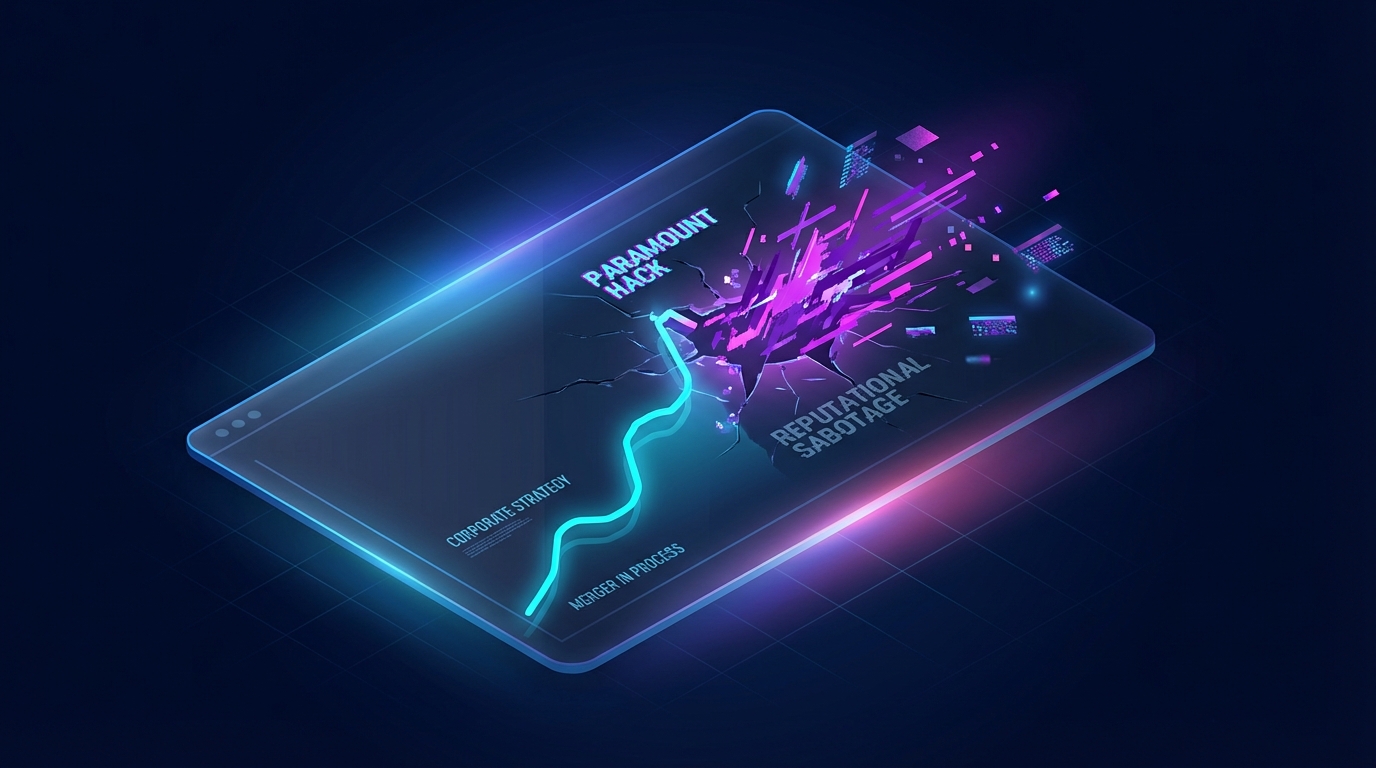
The Ideological Injection
The specific alteration of the bio to "Proud arm of the fascist regime" signals a shift from financial cybercrime to ideological sabotage. This fits the classic definition of Wikipedia's outline of Hacktivism, where digital tools are utilized to advance political or social causes rather than for illicit financial gain.
Why this mechanism is dangerous for brands:
- Brand Inversion: The attack didn't just silence the brand; it forced the brand to "speak" against its own values.
- Ambiguity: Until the account is reclaimed and a statement is issued, the public is left in a state of confusion regarding whether the statement is a rogue employee or an external breach.
The "Trojan Horse" of Access
While we await forensic details, the mechanics of such takeovers rarely involve "breaking" encryption. They almost always involve bypassing authentication protocols. The vulnerability likely lies in the "grey zone" of access management—where marketing convenience clashes with security rigidity.
As detailed in Egnyte's guide to unauthorized access, these breaches frequently stem from privilege misuse or compromised credentials rather than software exploits.
Common Vectors in Media Breaches:
| Vector | Description | The Strategic Flaw |
|---|---|---|
| Shared Credentials | Multiple team members using one login. | Zero accountability; impossible to trace the leak. |
| Third-Party Apps | Scheduling tools (e.g., Hootsuite, Buffer) compromised. | The "Backdoor" remains open even if the main password changes. |
| Dormant Privileges | Ex-employees retaining access. | Failure of offboarding protocols. |
The Strategic Takeaway: The mechanism of the hack is less important than the mechanism of the failure. A trillion-dollar consolidation deal was momentarily embarrassed by what amounts to a failure in digital hygiene. This proves that in the modern campaign environment, your security perimeter is only as strong as your social media manager's password habits.
The Reputational Blast Radius
The timing of this digital vandalism creates a strategic liability that extends far beyond a temporary loss of account control. Occurring simultaneously with Paramount’s aggressive maneuvers in the market, this incident serves as a case study in asymmetric corporate warfare. When a legacy media giant is branded a "proud arm of the fascist regime" on its own platform, the damage isn't technical—it’s narrative.
The M&A volatility Multiplier
In high-stakes mergers and acquisitions, perception is a tangible asset. Paramount is currently navigating a volatile environment, marked by aggressive expansion strategies. According to The Hollywood Reporter’s coverage of the hostile bid for Warner Bros., the company is already under intense scrutiny from investors and regulators alike.
A security lapse during such a critical window sends a distressing signal to the market: operational negligence. If a media conglomerate cannot secure its primary public-facing communication channel, stakeholders may question its ability to integrate and secure a rival’s massive data infrastructure. The hack transforms from a PR nuisance into a legitimate due diligence concern for potential partners or targets.

The Shift to "Brand Denial of Service"
We are witnessing a pivot in hacktivist methodology. Rather than seeking financial ransom or data exfiltration, modern attackers are leveraging Reputational Denial of Service (RDoS). The goal is not to steal assets, but to weaponize the brand’s own voice against itself.
This incident follows a troubling pattern of security lapses for the studio. As noted in CSHub’s analysis of previous Paramount data breaches, the company has struggled with protecting personal data in the past. This cumulative history of vulnerability creates a "competence gap" in the public eye.
The Strategic Paradox: The swift restoration of the account highlights a disturbing truth: remediation speed is irrelevant to viral spread.
- The Technical Reality: The bio was fixed in minutes.
- The Social Reality: Screenshots of the "fascist regime" bio will circulate indefinitely.
In the digital ecosystem, the "Time to Fix" metric matters less than the "Time to Screenshot." Security teams must now operate under the assumption that any unauthorized post, however brief, becomes a permanent part of the brand’s digital footprint.
Architecting Digital Resilience
The Paramount breach serves as a stark litmus test for modern campaign infrastructure, demonstrating that brand sovereignty is only as strong as its weakest authentication protocol. For strategic decision-makers, this incident signals a necessary shift from "preventing hacks" to "managing the inevitable breach." You must treat your social media footprint not as a marketing channel, but as a high-value attack surface that requires military-grade governance.
To future-proof your organization against similar reputational hijackings, you must implement a "Zero Trust" social media policy immediately. This involves moving beyond basic password hygiene into a structured defense architecture.
Strategic Implementation Framework:
- The "Kill Switch" Protocol: Establish a clear chain of command for who has the authority to lock down accounts instantly.
- Decentralized Authentication: Eliminate shared logins in favor of seat-based enterprise access tools (like Sprinklr or Khoros) to audit every keystroke.
- The 15-Minute Drill: Regularly test your team's ability to recover a compromised account within a quarter-hour window.
According to the Digital.gov social media cyber-vandalism toolkit, agencies must prepare specific recovery workflows and contact chains before a crisis occurs to minimize the "chaos window."
The Executive Takeaway: If you cannot control who speaks for your brand at 3:00 AM on a Sunday, you do not fully control your brand. The cost of implementing robust digital governance is negligible compared to the long-term tax of a shattered reputation.
TL;DR — Key Insights
- Paramount Pictures' X account was hacked and falsely stated they were the "Proud arm of the fascist regime."
- The hack occurred during Paramount's hostile $108 billion bid for Warner Bros. Discovery, suggesting strategic disruption.
- This incident highlights the vulnerability of corporate social media as a "soft underbelly" for reputational warfare.
- Account hijacking is surging, with a 1,000% increase, indicating low entry barriers for attackers.
- Organizations must treat social media as critical infrastructure, not just marketing, to prevent reputational damage.
Frequently Asked Questions
What happened to Paramount Pictures' X account?
Paramount Pictures' official X (formerly Twitter) account was compromised. The attackers altered the account's bio to read "Proud arm of the fascist regime" and posted unauthorized, politically charged content.
When did this hack occur and why is the timing significant?
The hack happened during Paramount's aggressive $108 billion hostile bid for Warner Bros. Discovery. This timing suggests the attack was a calculated disruption aimed at impacting high-stakes corporate maneuvering and market perception.
What is the broader implication of this hack for corporations?
This incident highlights the growing trend of "reputational denial of service" and "asymmetric warfare" targeting corporate social media. It demonstrates that social media accounts are critical infrastructure, vulnerable to low-cost attacks that can cause significant reputational damage.
How common is this type of social media account hijacking?
This type of incident is surging, with reports indicating a 1,000% increase in social media account hijacking. The low barrier to entry, often through compromised credentials or social engineering, makes it an increasingly popular attack vector for bad actors.
What should organizations do to prevent similar incidents?
Organizations must treat social media as critical infrastructure, implementing robust security measures like decentralized authentication, clear kill switch protocols, and regular breach simulation drills. Basic password hygiene is insufficient for protecting brand sovereignty.