The Inversion of the Panopticon
For decades, the strategic assumption in public safety and governance was simple: the state observes, and the citizenry is observed. That dynamic has shattered. We are no longer operating in a traditional surveillance state, but rather an ecosystem of "sousveillance"—recording from below.
The proliferation of high-definition mobile sensors has democratized intelligence gathering. It is not merely that privacy is eroding; it is that the monopoly on documentation has dissolved. Campaign professionals and civic leaders must recognize that control of the narrative is no longer about release timing, but about surviving the ubiquity of the public lens.
This shift is driven by accessible, dual-use technology. As noted in Wired's analysis of the new surveillance landscape, the tools of documentation—from drones to 4K pocket cameras—have shifted from specialized government assets to commoditized consumer goods. This effectively turns every constituent into a potential broadcaster and every interaction into a permanent digital record.

The Mutually Assured Documentation Trap
This democratization creates a complex tactical environment. While citizens record the police to ensure accountability, law enforcement agencies are simultaneously deploying increasingly sophisticated monitoring tools. According to The Marshall Project's report on protest surveillance, police departments are leveraging advanced aerial drones and cell-site simulators to maintain their observational edge.
This creates a paradox of "Mutually Assured Documentation."
- The Public: Uses video to challenge official narratives and expose misconduct.
- The State: Uses body-worn cameras (BWCs) and surveillance grids to gather evidence and justify use of force.
For strategic decision-makers, the implication is stark: operational opacity is obsolete. In an environment where civilians surveil the state as aggressively as the state surveils them, the only viable reputation management strategy is radical transparency. You cannot hide the footage; you can only hope your version aligns with the public's raw feed.
The Evolution of Counter-Surveillance
The dynamic of "watching the watchers" represents a fundamental restructuring of power dynamics in public spaces. We have moved from the era of grainy, accidental camcorder footage to a reality of high-definition, livestreamed accountability. For campaign professionals and civic leaders, this shift signals the end of information asymmetry.
The legal framework supporting this movement has hardened significantly in recent years. According to Middle Tennessee State University's First Amendment Encyclopedia, federal courts have increasingly recognized a First Amendment right to record police officers performing their duties in public. This legal protection turns every smartphone into a sanctioned oversight tool, dissolving the state's monopoly on the "official narrative."
However, this radical transparency creates a complex paradox. While the goal is accountability, the mechanism is the total erosion of privacy for all parties involved.

The technological landscape has outpaced the regulatory environment, creating a volatile operational theater. As noted in Stanford Lawyer's analysis of civil liberties, we are grappling with a surveillance ecosystem that captures data indiscriminately. The distinction between "public safety" and "mass surveillance" has blurred, driven not just by government investment, but by civilian adoption of military-grade optics.
Key Drivers of this Shift:
- Decentralized Hardware: High-quality drones and cameras are now consumer commodities.
- Cloud Connectivity: Footage creates immediate, immutable off-site records.
- Cultural Norms: The public expectation that unrecorded interactions are inherently suspicious.
For strategic decision-makers, the lesson is clear: You cannot rely on obscurity. In a world where civilians are equipped to counter-surveil the state, your organizational strategy must assume that every interaction is public data. The only viable defense against this level of scrutiny is operational excellence that withstands the glare of a thousand lenses.
The Democratization of Oversight
The historical monopoly on surveillance—where the state watches the citizen—has shattered. We are entering an era of "sousveillance," a strategic inversion where the observed monitor the observers. For campaign directors and policy strategists, this represents a fundamental shift in power dynamics: transparency is no longer a policy choice; it is an environmental inevitability.
This shift is driven by the collapse of entry barriers to military-grade optics. High-resolution sensors, once the domain of three-letter agencies, are now available on Amazon with next-day delivery. This hardware proliferation creates a decentralized dragnet that operates independently of government oversight or budget cycles.
The Legal Shield of "The Right to Record"
Technology is toothless without legal protection. The crucial enabler of this movement is the judicial recognition that recording public officials is a constitutionally protected act. This transforms the civilian smartphone from a passive device into an active instrument of checks and balances.
According to the Virginia Law Review's analysis of third-party recording rights, courts are increasingly affirming that the First Amendment protects the right to secretly record police interactions. This legal framework provides the "air cover" necessary for civilians to operate as independent auditors of state power without fear of immediate legal reprisal.

The Mutual Accountability Loop
The presence of these devices creates a psychological pressure cooker known as the Hawthorne Effect—subjects modify their behavior simply because they know they are being observed. This creates a fascinating dynamic where the distinction between "police tech" and "civilian tech" becomes irrelevant to the outcome.
The result is a forced behavioral modification. A systematic review of body-worn cameras indicates that the presence of recording devices influences the conduct of both officers and citizens during encounters. The camera acts as a neutral third party, enforcing a "mutual accountability loop" where deviation from protocol carries immediate reputational risk.
The Transparency Trap
However, this democratization carries a significant strategic downside: The Context Collapse.
While the EFF's 2024 review of the Atlas of Surveillance highlights the massive scale of police technology deployment, the counter-surveillance movement often lacks the institutional frameworks to process data contextually. A civilian video is raw, unedited, and often devoid of the precipitating events.
This creates a volatility paradox:
- Institutional Surveillance is slow, bureaucratic, and evidentiary.
- Civilian Surveillance is instant, viral, and emotional.
For leadership, the danger is not just being recorded; it is the weaponization of partial truths. A ten-second clip on social media can dismantle years of community trust before the "official" footage can even be downloaded from the server. The strategic challenge is no longer about hiding from the lens, but about surviving the narrative speed of the footage it captures.
The Asymmetric Arsenal: Drones and Decentralized Data
The monopoly on surveillance technology has effectively collapsed. For decades, law enforcement agencies operated as the sole proprietors of forensic observation, utilizing tools that were financially and legally out of reach for the average citizen. Today, that dynamic has inverted into what strategists might call "The Asymmetric Arsenal." Civilians are no longer just passive subjects; they are active operators of a decentralized intelligence network that often rivals the capabilities of local precincts.
The Democratization of Air Superiority
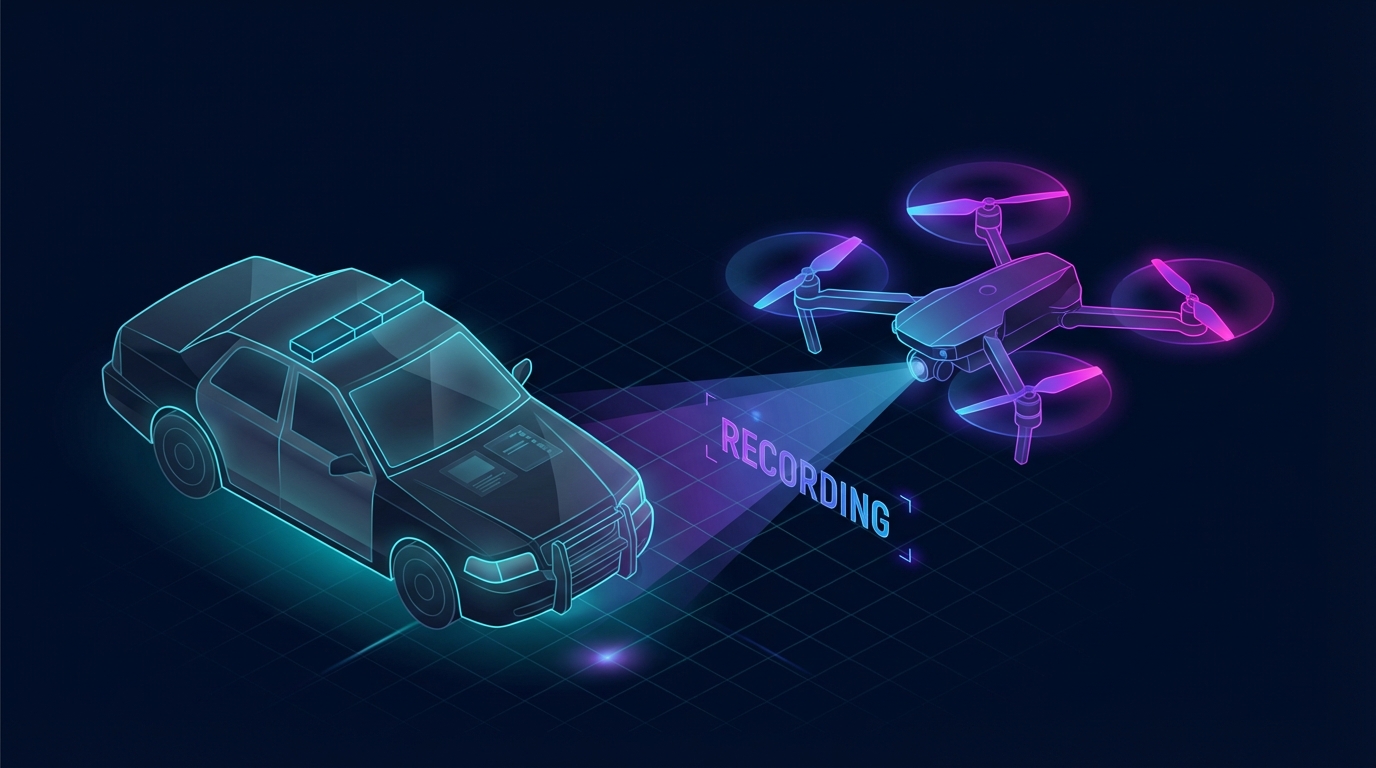
The most visible shift is the civilian deployment of aerial assets. Commercial drones have lowered the barrier to entry for aerial surveillance from millions of dollars (helicopters) to a few hundred dollars (quadcopters). This allows activists and concerned citizens to document law enforcement activities from vantage points previously reserved for state actors.
According to Aaron Swartz Day's overview of surveillance equipment, the proliferation of these technologies means that the "eye in the sky" is no longer exclusively blue. This creates a tactical dilemma for agencies: they must now operate assuming they are being observed from above by agile, high-resolution sensors that can broadcast live to social platforms instantly.
The "Always-On" Mesh Network
Ground-level surveillance has undergone a similar transformation through the saturation of smart home technology. Video doorbells and private security systems have created an inadvertent, city-wide mesh network. While police often request access to this footage for investigations, the lens is agnostic.
- The Ubiquity Factor: A raid or traffic stop in a residential area is likely recorded by multiple angles simultaneously.
- The Storage Shift: Footage is stored in private clouds, outside the chain of custody of the police department, making it immune to "accidental" deletion or bureaucratic obfuscation.
The Mirror Effect of Body-Worn Cameras
Perhaps the most ironic development is the cultural impact of police Body-Worn Cameras (BWCs). The initial push for BWCs established a new baseline expectation: interaction implies documentation.
This has triggered a behavioral shift known as the "civilizing effect," but it cuts both ways. Government Report's systematic review via PMC indicates that the presence of cameras alters the behavior of both officers and citizens, theoretically reducing use-of-force incidents. However, this has also trained civilians to view recording as a defensive necessity.
When the state legitimizes recording as a tool for truth, the public adopts the same standard. This legal standing is increasingly robust; Virginia Law Review's analysis of bystander rights emphasizes that the First Amendment protects the secret recording of police by third parties in public spaces. This legal framework turns every bystander with a smartphone into a protected, independent oversight committee.
Strategic Implication: The End of the "Official Narrative"
For campaign directors and policy strategists, this technological parity signals the death of the single-source narrative. You cannot control the story when the raw data is crowdsourced.
The Insight: In an era of decentralized surveillance, transparency is no longer a policy choice—it is a technological inevitability. Organizations must prepare for a reality where their actions are audited in real-time by the very people they serve.
The Accountability Paradox: The Unseen Impact
The democratization of surveillance technology has created a phenomenon sociologists call "sousveillance"—the recording of an activity by a participant in the activity. While the immediate goal is accountability, the secondary effects are creating a complex operational environment for public figures and institutions. We are witnessing a shift from hierarchical oversight to distributed auditing.

The Friction of Proximity
This new power dynamic has triggered a legislative and operational counter-response. As civilians assert their right to record, the state is attempting to redraw the physical boundaries of transparency. This tension is evident in recent legislative maneuvers where states are establishing "buffer zones" to limit how close bystanders can get to law enforcement.
Npr's report on buffer zone laws highlights the growing legal friction, noting that while the right to record is protected, the proximity of that recording is becoming a fiercely contested battleground. For campaign strategists, this illustrates a critical lesson: Technology moves faster than regulation, but regulation will always attempt to regain lost ground.
The Equity Gap in Surveillance
The motivation for this civilian-led surveillance is not evenly distributed. It is driven largely by communities that feel disproportionately targeted by state-sanctioned monitoring. This creates a feedback loop where high-surveillance zones become high-recording zones, intensifying the adversarial relationship between institutions and the public.
Brookings' analysis of police surveillance emphasizes that for communities of color, data privacy is not merely a preference but a civil rights imperative. When the state expands its digital footprint, the community responds by expanding its own digital documentation. This is not just "recording"; it is defensive data capture.
The Efficiency Trap
The paradox here is that while "cameras everywhere" was sold as a solution for safety, it has evolved into a tool for mutual paralysis.
- The Officer's Dilemma: Fear of viral context-stripping may lead to "de-policing" or hesitation in critical moments.
- The Civilian's Burden: The onus of accountability shifts from internal affairs to the citizen's smartphone battery life.
Strategic Implication: The Trust Economy
For political campaigns and advocacy groups, this dynamic proves that you cannot rely on "official channels" to validate your narrative.
The Takeaway:
- Assume Zero Privacy: Operate as if every interaction is being livestreamed.
- Context is King: In a world of 30-second clips, the organization that provides the most comprehensive context wins the narrative war.
- Embrace the Audit: Do not fight the recording; facilitate the transparency. Resistance implies guilt in the court of public opinion.
Your Next Moves in the Age of Radical Transparency
The normalization of civilian counter-surveillance signals a permanent shift in the power dynamics of public space. We are moving beyond simple video recording into an era of asymmetric algorithmic auditing, where the tools available to the public to analyze footage rival those of the state.

The Strategic Pivot: From Reaction to Architecture
Leaders must stop viewing civilian recording as an operational nuisance and start treating it as a permanent environmental condition. The future belongs to organizations that can navigate an ecosystem of total visibility without succumbing to paralysis.
According to Reuters's analysis of law enforcement technology investments, the future of policing rests heavily on how agencies adapt their technology stacks to meet evolving demands. This creates a parallel imperative for campaign strategists and civic leaders: you must build infrastructure that thrives on transparency rather than hiding from it.
Actionable Intelligence for 2025
To stay ahead of this curve, implement the following strategic imperatives:
- Democratize the Data Stream: Do not hoard the "official" footage. Release body-worn camera (BWC) footage proactively. If you force the public to file FOIA requests or rely on leaked civilian clips, you surrender narrative sovereignty to the most viral edit.
- Prepare for AI Scrutiny: The next wave of civilian oversight won't just be human eyes; it will be open-source AI models scanning hours of public footage to identify patterns of bias or non-compliance that a human observer would miss. Audit your own data before the public does.
- The "Buffer Zone" Strategy: Anticipate legislative battles over physical proximity. While the right to record is established, the distance is the new legal frontier. Advocate for clear, metric-based guidelines that protect operations without infringing on First Amendment rights.
The Bottom Line: In a zero-privacy environment, your only shield is competency. When the cameras are always rolling, perform as if the world is watching—because it is.
TL;DR — Key Insights
- Civilians are actively surveilling police using accessible technology, inverting the traditional power dynamic of state surveillance.
- This "sousveillance" creates a "Mutually Assured Documentation Trap" where both citizens and law enforcement record each other.
- Radical transparency is now essential for organizations, as operational opacity is obsolete due to ubiquitous public recording.
- The right to record police in public is increasingly legally protected, empowering every citizen with a smartphone as an oversight tool.
- Organizations must embrace transparency and proactively release data to control narratives, as viral civilian footage can precede official releases.
Frequently Asked Questions
What is "sousveillance" in the context of the article?
Sousveillance refers to the inversion of traditional surveillance, where civilians record and monitor the actions of authorities like the police, rather than solely being observed by them. This democratizes oversight.
How has technology contributed to this shift in surveillance?
The proliferation of affordable, high-definition consumer technology like smartphones and drones has made it easy for anyone to record, effectively turning every citizen into a potential broadcaster and every interaction into a documented event.
What does "Mutually Assured Documentation" mean?
This term describes the situation where both civilians and law enforcement are constantly recording each other. It creates a paradox where the state uses surveillance for evidence, while citizens use it for accountability.
What is the "Transparency Trap" mentioned in the article?
The Transparency Trap highlights the risk of viral, context-less civilian footage undermining official narratives before full information is available. Organizations must proactively manage their data to avoid this.
What is the strategic implication for organizations and leaders?
Organizations must abandon operational opacity and embrace radical transparency. In an era of ubiquitous civilian recording, their only viable strategy is to perform with excellence, assuming all actions are public.